Showing posts with label Alaska Ferry. Show all posts

Tuesday, August 30, 2016

Floating home from Alaska

Our trip home on the Alaska ferry started in Skagway; Alaska, which punctuates the top of the picturesque north-south Lynne Canal. Standing on the deck of the MV Leconte (one of the original Alaska ferries), mountains towered over us to both the east and west sides. As we moved away from land on our way south through the Inside Passage, even the four cruise ships we left behind were dwarfed by the setting.

The Leconte is overshadowed by the cruise ship
and the mountains.  Notice Harding Glacier
at the upper left.

I was excited to be moving out onto the water. I left Lynne in the comfortable observation lounge and ventured out on the deck. The wind picked up my hair and billowed my jacket. As the land receded, the sky revealed itself, filling the space above and beyond the islands and mountains. In the coming days, from the ferry, I saw endless vistas of mountains receding into clouds, shorelines overlaid with early morning fog, and trees blurred through mist, the atmospheric conditions softening the steady, slow passage south.  In that way, all four legs of our trip on the Alaska ferry were similar, although each offered a view of a lighthouse, a glacier, or a narrow channel to define where we were. Then, the appearance of houses, piers, cruise ships, and marinas signaled that we were approaching our destinations.

The back deck of the MV Fairweather

Lynne and I took three different Alaska ferries, embarking first from Skagway, stopping for a couple of days in Haines, one night in Juneau and two nights in Sitka. I loved watching the coast diminish quickly each time we pulled away from the dock.

I felt safe and also connected with my ship community, the passengers and the crew. Occasionally, the ferry sailed past cruise ships or fishing boats, but mostly, we were alone on the rolling water. I got used to the feeling of the deck moving slightly under my feet. I had to pay attention as I walked the halls.  I held onto the railings as I went up the stairs.

Travelling on the ferry through southeast Alaska gave me a visual context for how sparsely populated this part of the world is, how much of the land is uninhabited or uninhabitable. Mountains and water separate the human holdings. Each town operates in its own sphere, claims its own part of the shoreline, apart from its nearest neighbors. “Near” is a relative word when the towns are separated by icefields or steep impassable mountains rising sharply from the sea. What ties these southeast Alaska communities together is the water, the water which provides vital transportation and livelihood to the residents.

A view of Haines, Alaska as we head south on the ferry

Each of the three ferries (the Leconte, Fairweather and the Matanuska, all named after glaciers) had comfortable indoor observation lounges with ample windows for those absorbed in the passing beauty. I brought a book to read, but hardly got a page read.  I saw some people doing jigsaw puzzles, or knitting, but most were gazing out the windows or just leaning on the railing and scanning for wildlife. With no Wi-Fi on the ship, people passed much of the time talking to each other. 

Lynne and I had fun meeting new people, like Donna and her husband Joe from Georgia. They are as old as we are (depends on your perspective how old you think late sixties is), so we were surprised to learn that they were sleeping in their VW Golf as they traveled across the lower 48 and up to Alaska. Their claim to fame: bragging rights for getting 50 mpg with their diesel engine.  We made friends with Lexie and her husband from Oregon.  They trek up to Juneau to fish in Excursion Inlet each summer. This year they were returning with 1300 lbs of halibut that they caught. Lexie is originally from Juneau, and has memories of smoking fish with her Tlingit grandmother at the family’s fish camp.  Her husband gave me good directions for gathering huckleberries on Mt. Adams.

At night, I experienced sleeping on the boat, the bed gently rocking. I had the feeling of motion and simultaneously the feeling of deep relaxation that came with leaving the navigation and driving to the crew, covering distance in the dark as we slept. In the middle of one night, extra turbulence in the water awakened me, swaying me back and forward in my bed, but I soon fell back to sleep.

A deck hand prepares the ropes for landing

At breakfast, the purser made a quick announcement over the loudspeaker, alerting us to look out the window.  Standing up to see better out the wrap-around dining room windows, we watched about eight humpback whales fishing near the ship, their breath spewing up water, their fins slicing through the surface, their broad dark flukes (tails) flipping up as they dove. Before our food could get cold, they were gone.

The food was fun. The ship’s white jacketed cooks offered up their food cheerfully.  The kitchen was open most of the day.  It was a classic cafeteria line with trays that you slid down stainless steel rails, the heat rising from steam tables with oatmeal, soup or chili. Specials were listed on a white board for every meal.  After ten days of eating our own (very healthy, well planned) cooking while we were camping, both Lynne and I indulged in the kitchen's cooking.  The last morning, I had enough huevos rancheros to feed a ranch hand, and I enjoyed every bite.

Throughout our trip in Alaska in early August, we wore long pants and long sleeves, occasionally pulling on raincoats.  Southeast Alaska is in a rainforest, so we had expected the foggy weather, the showers, the cool air.  We had prepared for this weather and actually welcomed it after some hot days driving through southern BC. We heard occasional reports that the rest of the country was having a heat wave. 
 
Navigating the Peril Strait on the way to Sitka

The large boat that we were on for 36 hours was the MV Matanuska. It moves at approximately 19 mph (16.5 knots), day and night, carrying about 200 passengers and their RVs, cars, motorcycles, kayaks and bicycles. We traveled on it for 36 hours, from Sitka to Juneau, Juneau to Petersburg, then on to Wrangell, Ketchikan and finally our destination, Prince Rupert. For us, distances were measured in time, not miles.  Juneau to Sitka is about 110 miles as a plane flies, but took 4 ½ hours by the fast ferry MV Fairweather), or eight hours by the larger Matanuska. 

One lane of RVs being loaded on the ferry in Skagway.  Notice the smallest RV.  That's ours!
 Lynne and Winnie are standing in front.
Two cruise ships block the mountains behind the scene.


Tracing our route on the map, the ship went south from Juneau on the Chatham Strait, then east, slowing down to negotiate the Peril Strait and ending up south again on the Neva Strait to Sitka. You could skip all this cruising and instead get there in 40 minutes by plane. Instead, we returned to Juneau on the Matanuska. Our ultimate destination was Prince Rupert, 318 miles from Juneau.  We left Juneau at 5:15 am on Monday and traveled 29 hours south on the Stephens Passage to Frederick Sound and Petersburg, through the Wrangell Narrows to Wrangell, through the Clarence Strait to Ketchikan, through the Dixon Entrance to Prince Rupert.  We arrived at 10:45 am on Tuesday.

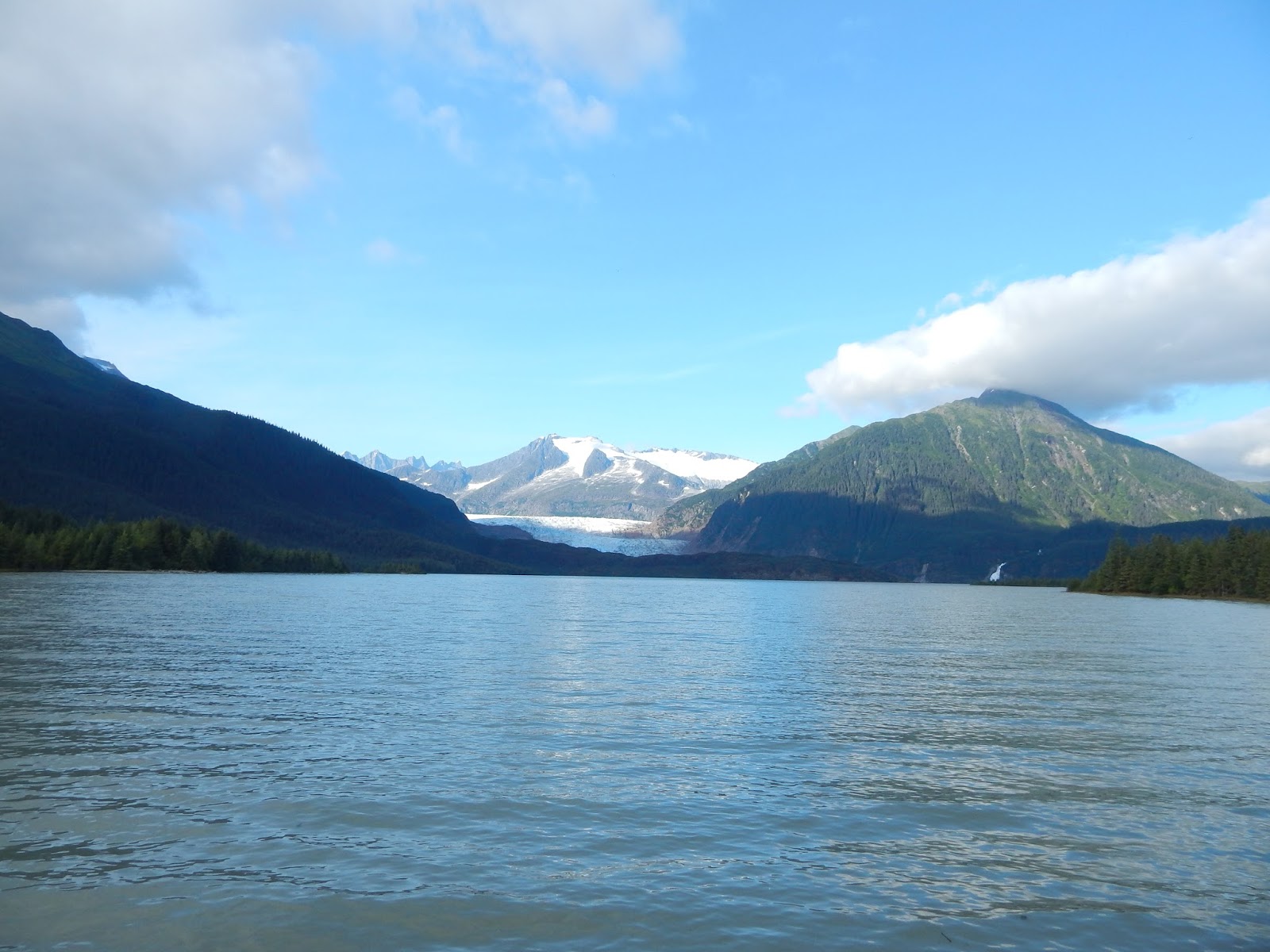
Approaching Juneau on the ferry, with a view of the Mendenhall Glacier.

I am an insider of the Alaska ferry system, because my job is to provide shoreside support to the ships which dock in Bellingham. Each week, I get to help the Alaska bound passengers through the boarding process. I chat with retirees who are taking their RVs to Alaska for their once in a lifetime trip. I answer questions for young military families who are relocating to Sitka or Kodiak or Anchorage. I help young people who are going up to Petersburg to process seafood for the season, men sending their new boats up on the ferry, homeless people who are pinning their hopes on Alaska, and Alaskan residents who came down to shop, to visit relatives, to buy a new car, or have a medical issue addressed.  I have coached young people who are pitching their tents on the top deck. I have relayed messages to the ship from distraught drivers who are caught in Seattle traffic or behind an accident and are late for the ferry. 

In the process of helping passengers, I have gotten to know some of the crew, from the watchman to the stewards to the pursers to the captains and the able bodied seamen and seawomen. It was fun to see them again in Alaska, and to meet more people who work on the ferry. 

When I was first hired, in 2010, an immediate bonus was that my training included a trip up to Ketchikan on the ferry for training.  I wrote a blog about it at the time, telling the story of going up to the bridge to see how the ship is steered, and in Ketchikan, donning a lifejacket and walking the scaffolding to learn to tie up a ship.  I was on an adventure then, although not exactly a relaxed one, as a new employee.

I am no longer new to the Alaska ferry system, yet the experience of being on the  ferry as a passenger during our recent trip was still an memorable adventure.

I came across these words from “The Blue Boat Home” by Peter Mayer this week, and they express how I felt about our sea journey:

 I give thanks to the waves upholding me,
 hail the great winds urging me on
Greet the infinite sea before me
Sing the sky my sailor's song 


Saturday, July 23, 2016

On Going North

We are leaving in the morning, driving north, in the direction of longer days, just east of the coastal mountains through the interior of British Columbia

Our shopping list included mosquito nets and bear spray.  We will be traveling through Hells Canyon and Kitwango.  We have to be sure to fuel up before long stretches with no gas stations.  We won’t have cell service for much of the drive. It takes two AAA maps to trace our route.

We will brush with glaciers, look for bears, and explore this new direction. We are traveling in our 1993 Toyota Dolphin camper.  Maximum speed: 55 mph.  Gas mileage: 14 mpg average.

I am looking forward to waking up each morning in our nesty camper, sliding open the curtains and looking out on 10 Mile lake or a meadow in the shadow of a mountain. I look forward to having nothing more pressing to do than make breakfast, go for a walk, and drive to our next campground.  I look forward to being a minority among the mammals around us and a spectator to nature’s symphony.


We’ll make it to southeast Alaska, and then float our way home, slowly, on the Alaska ferry. I look forward to this sail: the passing islands, the possibility of seeing humpback whales or white sided dolphins, of watching the shorelines and the distant peaks. I look forward to the meditative experience of not being in charge, of letting the captain do the driving and absorbing the energy of the Inside Passage, immersion in a vast place where my presence is insignificant. 

I can generalize that this is what I am looking forward to that motivates all the effort required to get us on the road.  I want to wake up in peaceful places, hearing birds, wind, and not much more.  No background of traffic on I-5, no piercing distant train whistles, no sirens, no neighbors starting up their engines.  I want to walk along nature rich paths with close up encounters with northern trees and vegetation, clear lakes, awesome geological formations and vistas of mountain peaks.  I want to be outnumbered by animals and birds, I want to be an inconsequential presence in ecosystems that are not overrun with humans.

T minus 18 hours, and counting.

Sunday, February 7, 2016

Digging for Gold

           
As I crossed the empty parking lot in the dark, the streetlights reflecting off the wet pavement, I felt the weight of the long winter season: short days, rainy weather, gray skies. No eager passengers were waiting for me to open the ferry terminal. The Alaska Ferry was in the doldrums of our winter season, past the boost of the winter holidays and not yet into the awakening of spring. The number of people interested in traveling up to Alaska in the dead of winter was typically low: fewer than 100 passengers today, a third of the load during the summer season. At a few minutes before seven a.m., I unlocked the side door of the spacious brick terminal building and let myself in. Usually pulling up to the waterfront early in the morning, the fleet of boats rocking in the water, the wind stirring, the openness across the bay uplifted me, stirred my soul. This morning, the world just seemed dark and rugged. What was the point?
            The day stayed dark and rainy, one more in the string of dark January days here in Bellingham.  Even with mild temperatures, the rain drove everyone who had a place to go indoors.  The passengers who came to my window dripped rain off their hats.  Their winter jackets were soaked from the dash between their cars and the terminal. They unpeeled their layers and parked their rolling luggage in a pool of water as they negotiated the process of checking in.
            The morning had passed slowly.  When we opened our ticket windows at 8, I checked in a few veteran employees and retirees of the Alaska ferry system who were traveling on pass.  I helped a woman who had been told incorrectly that she had to check in by 8 a.m., instead of 3 p.m., for the 6 p.m. departure.  Luckily the ample two story terminal offered plenty of space for the waiting passengers to spread out during the intervening hours. To fill the time until the rush of passengers later in the day, I turned to updating the fare sheet for the summer sailings.
            The smell of unwashed clothes and body registered across the counter at my ticket window before a word was spoken.  He was gray haired, not recently shorn, and bearded. He was wearing a nondescript army jacket. His body tilted forward to counter the weight of an enormous green duffel bag he carried on his back.  His face was pock marked and ashen, other than his red nose. In one hand was a cardboard sign.
            “How can I help you?” I said, intentionally disguising my gut reaction to the acrid smell.
            “I finally have enough money,” he said, as he smacked a worn white envelope thick with cash on the counter.  “Or at least I hope I do.  I want a ticket to Juneau. Two hundred and sixty dollars.”
            I looked at the envelope, at least an inch thick with bills.
            Keeping my voice casual and friendly, I told him the price to Juneau, $363.  My approach was designed not to ignite angry spirits.
            He looked confused, then said “I panhandled all week to get this.  I should have enough.” He stuffed the cardboard sign under the duffel on his back.
            “Let’s see,” I said as I turned my attention to my reservations screen, leaving the white envelope on the counter. 
            “I’ll need to see your ID.”  Checking ID was required, but also helped me clarify the situation.  Did he have one?  Where was he from?  How old was he?
            He pulled his license out of his wallet and handed it to me.  It was surprisingly clean. His name was Paul Martin. I noted his home address: Chico, CA
            “You’re a ways from home,” I said, to be conversational as I began creating a new passenger profile in the system. He didn’t reply. “Have you been on the Alaska ferry before?”
            “No ma’am,” he said.
            His license was up to date. His picture showed a younger, more prosperous version of himself: fewer gray hairs, clean shaven, smiling.  I checked off the box marked “New Passenger,” on the computer and began filling out the form: his name, birth date, and driver’s license number. I mentally calculated his age: 55. He has lasted this far, I mused, and still has some miles left to go.
            I asked if he had an email address or phone number, even though I correctly predicted the answer: “No.” I finished filling out the form, putting in his California address, even though it was apparently not current. “You’ll need $363 to get to Juneau,” I told him. “Let’s count your money.” Taking the stack of money out of his envelope, I started slowly counting it out loud.  He watched me as I concentrated on the pile of money. I sorted out some twenties, then a few tens, and totaled 55 dollars in large bills.  The rest of the bills, all ones, were crinkled and bent.  I straightened them as I counted, starting over several times.  I reached $100 and I was half way through the stack.  I didn’t think we were going to end up with $363.  I was right.  At $201, we ran out of bills. I hated to disappoint him.
            “We could get you as far as Ketchikan for $263,” I offered.  He looked at me.  “You would need 62 more dollars.”
            “How much?”
            “62 more dollars.”
            “I thought I had enough,” he said.  He lowered his voice and leaned forward a bit, “Would you let me pay the rest later?”
            “No.  Sorry.” I inwardly wished I could have granted his request.  Turning down people who are trying to get on the boat with their last dime was hard on me.  People on their last dime are hard on me. The idea of going to Alaska seems to give hope to people who have burned all their bridges in the lower 48 states. Everything is going to be different in AlaskaAlaska is the answer to their problems. In the six years that I had worked as a terminal agent, I saw this pageant play out more than I wanted to.  I didn’t ever want to be in their position. I didn’t want anyone to be in my position. With a swipe of a credit card, I could have paid his way.
            He considered. “How much more do I need?”
            “62 dollars to get to Ketchikan.” Then I asked casually, “What’re you going to do in Alaska?”
            “Dig for gold,” he answered right away. This man was hoping to strike it rich.  This business plan proved to be the death of many travelers since 1897 .  It was a rugged and risky prospect then.  It was just ignorance now.
            “The gold might be covered with snow,” I said in a low voice. I tried to be respectful and casual, stifling the many other opinions that were screaming across my mind. He looked down and didn’t reply.
            “Is Ketchikan a city?” he asked. I was glad he asked.  I wanted to help him.  He could have been my brother.
            “Yes, it is a city.”
            “Which is bigger, Ketchikan or Juneau?”
            I thought about it. “I’d guess Juneau is bigger,” I said. “It is the capital.”
            “But Ketchikan is a city?”
            “Yes.” I had been there only once, but I knew there were at least several thousand residents.
            “Are the people friendly?”
            I wasn’t sure how to answer. “Yes, there are friendly people.” I could have just as easily said no, but I hesitated to burden him with too much reality.
            He debated for a few minutes.  I showed him a map of Alaska and pointed out Ketchikan, the first stop on the ferry; and Juneau, several hundred miles north.  He noted that he couldn’t really see the map without his glasses. When he persisted about going to Juneau, I told him that another ferry runs every few days between the two cities. When he asked the cost of that ferry, I looked it up under Tariffs on my computer and told him the figure.
            “How much more do I need to get to Ketchikan?” Third time.
            “62 more dollars,” I repeated. I put the money we had just counted back in his envelope and handed it to him. As far as I was concerned, we were at a dead end.
            His mood seemed to shift. “I’ll have to get some more money,” he said in a determined tone. He pulled his cardboard sign from between his duffel bag and his coat.  Somehow, he had kept the sign completely dry.  “Could you reach my pen?” He turned sideways and moved closer to the counter so I could reach into his duffel.
            I didn’t want to touch his duffel, let alone search around in it.  “Here, use this,” I said as I handed him a black magic marker from my desk.
            He leaned his sign on the counter, still holding the huge pack on his back.  I watched as he carefully wrote “I need $62” in large, perfect lettering, then outlined the numbers several times to make them stand out. I glimpsed the words “Help” and “Alaska” under his arm as he wrote. When he finished updating the sign, he handed me back the marker.  I was impressed by the care he took with his sign, and that he had kept his cardboard sign in such good condition in this weather.
            “Where did you have the best luck getting money?” I asked out of conviviality and curiosity. I pass panhandlers frequently but I never speak to them. Yet I always feel bad for them.
            “The grocery store.” He glanced at me as he answered quickly.  He hiked up his duffel and turned to go.  He seemed to have an afterthought. “Do you know a church or anybody that helps people?”
            “The only place I know is the Mission.”  If he had more time, I might have offered him other options: the local Episcopal Church, or the Opportunity Council.  But we only had four hours before the ship started boarding passengers.
            “The Mission!”  I felt the strength of anger as his face turned sour. “They don’t help anybody.  I told them what I needed and they said ‘We don’t do that here.’” He mimicked a tense face and a callous voice.
            “That’s all I know,” I said quietly.
            “I hope I get that money.”
            “Me too. Good luck,” I called after him as he started to walk away.  I wasn’t sure I’d see him again, but I might. He had $201 in his pocket.  He might not be back.
I jotted down his reservation number on my desk calendar before I cleared the screen.
            Passengers kept turning up as the morning stretched into mid-day, the rain let up and the sun made a welcome appearance.  I took my lunch break upstairs in the terminal to get out of the crowded office.  It was both quieter and warmer up there, and I could stretch my legs out on the red seats and look out the window as I ate leftovers. I heard people calling to each other about the rainbow that you could see to the north. I thought about this passenger. He could be one of many men in my generation.  The streets of Bellingham were full of people living outdoors, on sidewalks, under bridges, in the woods. I wish I had a magic wand to fix this one problem. My friends tell me I have a tender heart. Maybe so, but I can picture myself with no place to live.  The anguish of insecurity would drive me crazy. I don’t like danger.  I don’t like hunger. I am grateful that I have a lovely, secure home with my life partner, but am I one earthquake or one financial catastrophe away from being on the streets myself?  I don’t feel that different.  All housing is temporary. All bank accounts can be emptied.
            After lunch, I went back to work on the new handout listing the upcoming summer fares. A rush of passengers turned up, and I stayed busy checking IDs and processing their tickets.  For those taking their cars, I instructed them on where to park, and what to expect, and I directed the walk-on passengers to the white booth out front.  After most of the passengers had checked in, I looked up from my work and there he was at my ticket window, his duffel still hoisted on his back and his cardboard sign in one hand.
            “Hey,” I smiled at him.  He dropped the white envelope on the counter, then reached into his coat pocket and pulled out a handful of cash. 
            “I should have enough now,” he said breathlessly, putting the rest of the money on the counter for me to count.
            “OK, great,” I said, masking my surprise at his success. I straightened out the new pile of money and counted the stacks of crinkled bills. The total: $64. Added to the money in his envelope, he had enough to go to Ketchikan.
            “You have enough and one dollar left over.” I looked at his face. He smiled.
            I pulled up his reservation on the computer and entered $263 in the payment field. I clicked on the icon to print his ticket, then took his entire stack of cash, dropping his oversized pile of bills inside to organize later. I gave him back a lone dollar bill and then locked the cash drawer. I felt uneasy and sad. He was going to Alaska in January to dig gold with one dollar bill and his belongings on his back.
            “I’ve never panhandled that much money before,” he confided with pride as I handed him his ticket.  “Maybe $20 or $30, but not that much. It took me all week.”
            “Well, you got it.  Good job.” I smiled at him. He had shown persistence.  He had stayed organized and accomplished his goal.  He was also alone and naïve. I decided to let the motherly part of my brain speak. “Do you have food with you?” I asked quietly, hoping he wouldn’t be offended. I was thinking how I would feel.
            He hesitated before replying. “Yes,” he said, looking down at the counter.
            I still wasn’t sure he understood what he had just signed up for. “You aren’t going to get there until Sunday morning.  Today is Friday.”
            “That’s all right.”
            The ship had a cafeteria. I had heard that sometimes the Purser will hand out a cafeteria voucher to indigent passengers. I silently hoped that he would win that lottery. Meanwhile, I explained where he needed to go to board the ship.  “When you get on the ship, take the elevator up to the top deck.  There’s a place for you to stay there.”
            He turned to go, then stopped and asked, “Will it be dark when we get there? I was hoping it wouldn’t be dark.” My heart sank. Both at his fear and his naïveté.
            “It will be 7 am, so yes, since they are further north than we are, yes, it will be dark,” I said carefully. I wished I could have told him it would be daylight. I wished it were Disneyland. I wished he hadn’t revealed his concern to me. What I really wanted was for him to change his mind and walk back out our front door with his cash.  Alaska, January, alone, $1.  I felt stressed.
            “There you go! You are all set.” I smiled at him.  “Good luck!” I called as he walked away, actually hoping that my wishes would improve his chance of success. Or at least protect him from the worst.
            Heading past the other ticket windows, he held the ticket up in the air.  “I got it!”
            “Have a good trip,” my colleague called to him.
            The sun was down and darkness reigned again when the ship was finally ready to leave. All the vehicles had been loaded and the passengers were on board.  The car ramp was lifted, and the line handlers turned the ship loose from the pier. I heard the horn sound, indicating the ferry’s departure at 6 p.m. We closed our ticket windows and my colleague went out to lock up the gates as they pulled out.  When he came back he said, “Someone’s standing on the back deck waving his ticket saying ‘I’m going to Alaska! I’m going to Alaska!’ I think it was your passenger.”
            “Must be him,” I said, swamped by the image of his childlike optimism and his heartbreaking plan to make money digging gold. I was glad he had this window of good cheer before being tested by the reality when he walked off the boat in Ketchikan. I could only imagine his confusion in a strange, cold, dark place.  Where would he stay?  How would he eat? He didn’t have enough money to come back.  Who would help him?
            With the boat heading across the bay on its way north, I prepared my financial report of the day’s transactions. I opened my cash drawer and pulled out his wad of money and counted it once more.  I got to $263, and found that I had two extra dollar bills.  This couldn’t be right, I said to myself.  I couldn’t have taken two extra dollars from him. I recounted the money.  Same result.  The boat was already heading north.  He didn’t have a valid mailing address, a telephone or email address.  There was no way to get him the extra two dollars that I had taken from him. Of all the times to make a cash mistake, I couldn’t believe I had shorted him $2.
            Within a few minutes, we had locked up the terminal and turned out the lights. I walked back out into rain, back across the dark parking lot, and drove home.
            Lynne greeted me and asked about my day.  I told her about Paul, the money, the panhandling, the gold digging. I choked up as I described our interaction, especially the part about the dark and money for food. I was used to indigent passengers, but his flash appearance in my life on a day when life’s challenges were already weighing on me was too much. I helped him get on the boat. Should I have stopped him?  Lynne said I should have given him more money. As it was, I pictured his elation turning to disappointment when reality came crashing in on him. I sobbed when I got to the end of my story and told Lynne I found that I had taken two dollars from him.  She comforted me.  “You have a tender heart.”  Sometimes it feels too tender for this world.